
Honda produced its first electric motorbike in Vietnam
Honda Vietnam rolled out its first electric motorbike at the company's factory in Vinh Phuc on March 27th. ICON e: is the first pure electric product that the Japanese motorcycle and automobile brand has launched for Vietnamese customers, after roughly 30 years of dominating the gasoline-powered motorbike market with approximately 70-80% market share.
Before production, Honda had introduced the ICON e: and CUV e: at the Vietnam Motor Show 2024 back in October 2024 in Ho Chi Minh City. Among them, the ICON e: is produced in Vietnam, while the CUV e: is imported from Thailand.
The Japanese automaker will officially launch the product to the market in early April, at which point the pricing and sales policies will be more specific. At the exhibition at the end of last year, the company stated that the ICON e: would be sold with an expected price of under 30 million VND, not including the battery, while the CUV e: has not been released for sale but will be available through a limited-quantity leasing model in the two major cities of Hanoi and Ho Chi Minh City.
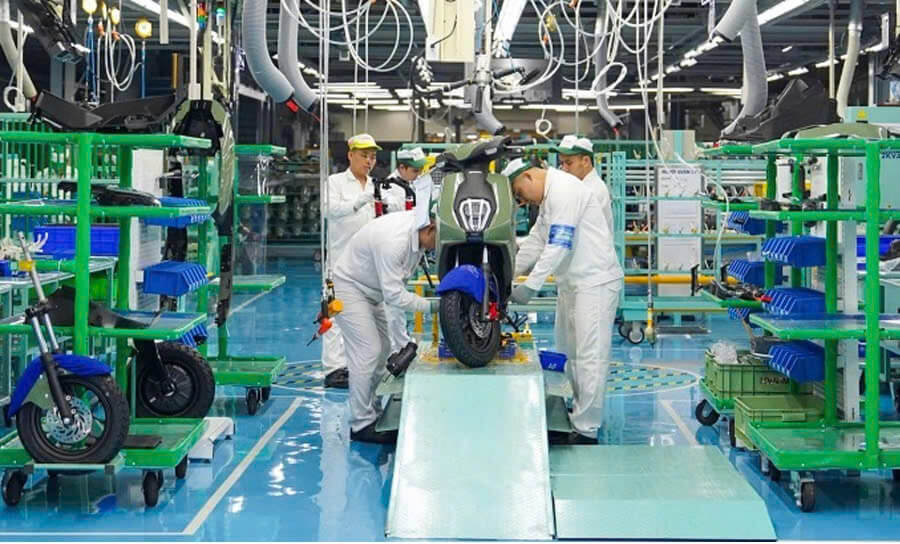 Honda Vietnam produces the ICON e: electric motorbike at its factory in Vinh Phuc on March 27th. Photo: Nguyen Linh.
The vehicle's length x width x height are 1,796 x 680 x 1,085 mm respectively, with a seat height of 742 mm and a weight of 89 kg. These dimensions are slightly smaller than the Vision (1,871 x 686 x 1,101 mm).
The bike is equipped with all LED lights, with the headlight specifically featuring an accompanying LED daytime running light strip. It has an LCD speedometer and a 26-liter storage compartment. Below the handlebars, there are two small storage compartments along with a USB charging port. It features a single disc brake at the front and a drum brake at the rear. The motor is located in the rear wheel.
According to Honda, the maximum travel range of the ICON e: is 50 km. Located under the floorboard (footrest) is a lithium-ion battery pack with a capacity of 30.6 Ah, an IP67 water resistance rating, and a weight of approximately 1.3 kg. The battery can be charged directly on the vehicle or removed for charging using a regular household outlet, taking 7.5 hours for a full charge. Specifically, charging from 30% to 70% takes 3.5 hours.
With its compact and fashionable design, Honda is positioning the ICON e: to target students. According to current regulations, individuals operating motorcycles with internal combustion engines of 50cc or less, or electric vehicles with a motor power not exceeding 4 kW and a speed under 50 km/h, are not required to have a driver's license. This Honda model meets these requirements with a maximum speed of 49 km/h and a motor power of 1.5 kW. The motor's torque on the ICON e: is 85 Nm.
With an expected price under 30 million VND, making it cheaper than the Honda Vision, and backed by a brand with decades of proven durability, the iCON e: is assessed by experts to be a product that will generate significant interest in the electric motorbike market. Furthermore, this will be a foundational starting point for Honda to gradually electrify its two-wheeled and four-wheeled products, as Vietnam is rapidly transforming to achieve its Net Zero target before 2050.
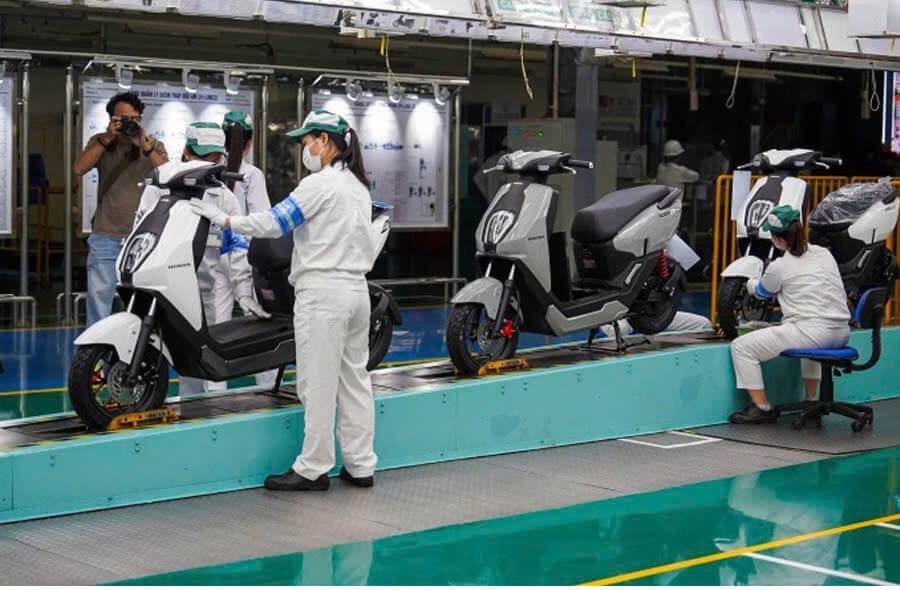 The ICON e: has been completed at the factory and will be released to the market starting in April. Photo: HVN
The electric motorbike market in Vietnam is currently dominated by VinFast, offering a wide range of products at various price points, alongside other players such as Yadea, Pega, Dat Bike, Selex..., as well as smaller-scale offerings from traditional electric motorbike dealerships. Among gasoline motorbike manufacturers, Yamaha offers the Neo's model priced at 49 million VND. Piaggio Vietnam has previously introduced a few electric products such as the Piaggio One and Vespa Elettrica, but has not yet released them to the market.
Having entered the Vietnamese market in 1996, despite being the top-selling motorbike brand, Honda has always appeared to take a "slow but steady" approach. The Japanese company's strategy is not to be a pioneer, but rather to wait for competitors to shape the market and for customers to become familiar with the product before entering the competition. Initially, the influx of cheap motorbikes from China crossing the border into Vietnam led Honda to introduce the Wave Alpha. A few years later, when Yamaha found success with the sporty scooter Nouvo, Honda also waited for a while before launching the Air Blade. Many years after that, when the Yamaha Exciter became the manual clutch motorbike that stirred up the market, Honda slowly introduced the Winner. Now, as other manufacturers have cultivated the habit of using electric motorbikes among consumers, Honda is finally entering the competition.
Contact
We provide services

Vietnam and the Republic of Cyprus Sign Double Taxation Avoidance Agreement

Vietnamese National Assembly Approves Investment Policy for Gia Binh International Airport

CNBC: Vietnamese Stock Market Forecast to See Strong Growth in 2026
Services For Foreigners


Bai viet gioi thieu